The shadow academy

Some academics are members of both the official academic world and a shadow one of racist pseudoscience

The case of Jason Arday, the black Cambridge professor who resigned after a campaign attacking his credibility, caused a lot of shock and anger, especially when he was found dead a few days later. The bigger story here in Belgium has been the controversy around one of his accusers, Nathan Cofnas, a post-doctoral fellow at the University of Ghent. Cofnas was suspended after Arday’s resignation, but has now been reinstated with some restrictions on his activities.

An article in De Standaard on Saturday (in Dutch, paywall) revealed that Cofnas is part of a network of academics and entrepreneurs who promote eugenics and racial pseudoscience. This network boosted Cofnas’ accusations against Arday, as part of a wider attack on diversity, equality and inclusion (DEI) policies in universities. Cofnas’ own training is as a philosopher of science: he presents himself as such on his website. His list of papers include no work in political science journals regarding liberalism, so it was mystifying as to why he was appointed to a post-doctoral position in a research programme on the future of European liberalism at Ghent. His new colleagues at Ghent protested his appointment on the grounds that he was unqualified. He had previously been fired from Emmanuel College Cambridge for his views on race expressed in his personal blog.

It seems that Professor Bouke de Vries played a key role in getting Nathan Cofnas appointed to his position at Ghent. De Vries had set up the research programme on European liberalism, and is himself researching the ethics of loneliness. However, according to De Standaard de Vries has also spoken at the London Conference on Intelligence, a secret conference discussing eugenics and the link between race and intelligence. He has refused to disclose the topic of his paper.

Neither de Vries or Cofnas are geneticists; their dayjobs are as a political scientist and philosopher of science respectively. Nevertheless they are members of a network of eugenicists and racist scientists, operating under the academic radar. Their opinions on race and intelligence have no scientific merit and would fail any review by their peers. It isn’t just Nathan Cofnas that is damaging Ghent University’s reputation; Professor de Vries is in a position to do much more harm.

Muganga

A review of Muganga – Celui qui soigne

Muganga – Celui qui soigne (“The one who treats”) is a biopic about Denis Mukwege, the Congolese gynaecologist who won the Nobel Peace Prize in 2018. It’s a powerful film, and much better than the average biopic. The film is structured around the collaboration between Mukwege and the Belgian surgeon Guy Cadiére, although Cadiére is no “white saviour”; Mukwege remains the moral centre of the story. It begins with a horrifying rape at the hands of soldiers, and the suffering of Mukwege’s female patients is key, because extreme sexual violence is being used as a weapon of war in the region.

East Congo is rich in minerals, in particular coltan, which is the source of elements that are essential for our modern technology. In the last thirty years, the region has been wracked by war, as neighbouring countries such as Rwanda and Uganda exploit local ethnic tensions to extend control over the coltan mines. In the film Mukwege explicitly points the finger at coltan mining as connected to the sexual violence that is being inflicted on his patients: the goal is to drive the civilian population away from the mines.

The European Union has close links with the Rwandan government, and has signed a deal on raw materials despite Rwanda’s ongoing interventions in East Congo. Europe is complicit in the violence, and unwilling to come into conflict with a regime that is a vital source of minerals, much looted from East Congo. The government of the DRC is also implicated, but compassion with the suffering of East Congo’s women has to be combined with action to break Europe’s collaboration with (some of) the perpetrators.

A scrapbook from Hell

One item from the Epstein files gives a glimpse into the life of a victim

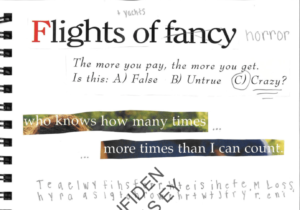
Among the vast dump of files from the U.S. Department of Justice relating to the Jeffrey Epstein investigation are many insights into the corrupt mentality of the rich and powerful, but one item upset me because it gave an insight into the psychological harm caused by Epstein’s cynical trafficking in girls and women. It’s a scrapbook, with the first page containing a birthday card for a sixteen-year-old and pages of dark messages spelt out using magazine cuttings. There are also hand-written notes, in a simple code (a two-rail “rail fence cipher”; this blog post provides a convenient decode). The notes tell a story of a girl being drawn into Epstein’s circle, apparently through Ghislaine Maxwell, and her increasing sense of being lost and abandoned by her mother. There are hints of bad encounters with named man, some identifiable such as Leon Black, former head of a big hedge fund and Epstein’s client, who she describes biting her. Next to a cutting about Ivana Trump’s divorce (on page 16) is the text “Does this lady know you cant have any dignity if you’ve been with him? I know I have none. Only skittles.”

The worst page is towards the end (page 27): “Flights and yachts of horror”. “They are always flights of horror whether its with Jeffrey…”[or a number of other men’s names]. “I am so confused by everything and people who you expect to be good like even old senators like George Mitchell who you think will be like a grandpa are bad.”

Sometimes the grammar is faulty, but that adds to the sense of authenticity. I assume that the document is genuine, and created by one of Epstein’s victims. Which one is not yet known. However the sense of being trapped in a world where you have no power is palpable and very disturbing. All she has is the desire to “survive with sensitivity and grace” (page 25). I hope that she has.

Slow Down: How Degrowth Communism Can Save the Earth – a review

Kohei Saito’s book on “degrowth communism” failed to convince me.

I was frustrated by this book. Its main argument is that attempts to “green” capitalism are doomed to fail, and only “degrowth” communism can save us from the climate crisis. However, he never really does the work of building his case step by step. I often had the feeling that he was simply asserting what he believed without taking me with him. I’m someone willing to be convinced: however I do think it’s a more complex picture than he makes out. The neoliberalism of the last 40 years and all the other shifts that have taken place have changed the nature of capitalism and capitalist society.

I also think there’s a problem with the author’s use of the idea of “degrowth”. He draws upon a reading of the (unpublished) researches of Karl Marx in his later life to argue that Marx rejected the notion of conquering nature and embraced a communism that would be more in harmony with nature’s limits. However Saito also flirts with the moralistic asceticism of the original promoters of degrowth, and applauds the inefficiency of his own model of communism. This seems to me very muddled. It’s more accurate to say that Marx believed in his later life in a sustainable communism, that would understand nature’s limits and work within them. This book has some good ingredients: global inequalities, the climate crisis, the nature of capitalism, but he doesn’t in the end produce a satisfying dish.

Israel has relativised the Holocaust

The Israeli state claims ownership of the memory of the Holocaust, but by inflicting famine on the people of Gaza it has itself compromised the memory of that experience.

When the Allies came across the Nazi death camps in 1945, it had a massive emotional impact. In my own country of origin (the UK) in particular, the reporting by the BBC from the newly-liberated Bergen-Belsen camp horrified the British public. [A personal connection: a friend of my father was one of the Liverpool University medical students sent to help care for the survivors. A microscope from the medical block at Belsen was in our family for some time; it’s now in the RAMC museum in Aldershot.] The Holocaust remains a reference point for evil and depravity, and a dark presence in the Western imagination. The industrialisation of murder on a vast scale, perpetrated by a nation renowned for its contribution to science and culture, has undermined everything that we believed about civilisation.

In the decades since then however, there have been attempts, coming mainly from the far right, to “relativise” the Holocaust, setting Hitler’s six million Jewish victims against Stalin’s supposed twenty million victims. On the other hand there has grown the idea that the Nazi genocide of European Jews is unique and sui generis, incomparable to any other genocide. This is alongside the growing association between the Holocaust and the Jewish state as the guardian of its memory (I’m uncomfortable with the term Holocaust, familiar with its original Ancient Greek meaning as a burnt offering, but it’s what we have). Such is the Israeli government’s influence over Holocaust memorialisation that the Israeli scholar Omri Boehm‘s invitation to speak at the commemoration of the liberation of Buchenwald this year was cancelled, at the insistence of the Israeli embassy, because of his belief that the slogan “Never Again” shouldn’t only apply to genocide against Jews (link to haaretz.com, registration required). This is a significant step in the nationalist appropriation of the Holocaust, in a country (Germany) where it is seen as a moral debt from one nation to another, rather than a warning to us all. The International Holocaust Remembrance Alliance, an interstate body in which Israel plays a leading role, includes in its definition of antisemitism “drawing comparisons of contemporary Israeli policy to that of the Nazis”.

Now we are assailed by new horrors, pictures of children starving to death in Gaza due to the Israeli government’s blockade of aid supplies. Whether or not a policy of genocide lies behind this (there is circumstantial evidence), the emotional impact of these images takes its toll. Given Israel’s character as a self-proclaimed Jewish state, they invite inevitable comparisons with the Holocaust. I will not be sorry if the moral authority of Israel over the Holocaust is weakened by these events. What I am worried about is that they will create cynicism about the Holocaust, especially in the minds of the young, and that does not bode well for the future.

Tariffs and imperial decline

Trump’s tariff wars have strong echoes of a similar moment in British imperial decline.

Donald Trump is finding out that trade wars are not easy to win after all. He was elected at least in part because of his promise to bring down inflation from the levels it reached under Joe Biden, but his long-held beliefs in tariffs will lead if implemented to rising prices. Moreover, what are his goals with his tariff wars? Is it to raise revenue? Or to force America’s trading partners to lower their own tariff barriers (“reciprocity”)? Or is it to protect American industries? He claims that these tariffs will bring back the industrial jobs that have been lost over the last forty years, to China and elsewhere. At different times he has claimed all of these are possible; however, the reality is that he can’t achieve all three goals at the same time. He has evoked the memory of President McKinley’s tariff policy, but McKinley’s tariffs were carefully targetted to protect specific American industries as they were developing. The only consistent theme is his sense of resentment of the countries that are running a trade surplus with the U.S. His tariff plans announced on 2nd April 2025 targetted those countries in direct proportion to the size of their trade surplus.

This all has strong echoes of a period in British history when tariffs also played a key rôle. In 1903 Joseph Chamberlain launched a campaign for tariff reform, specifically a system of “imperial preference” that would place a tariff barrier around the British empire. This was at a crucial time in the global economy; Britain had dominated world trade in the 19th century, promoting free trade and even fighting a war with China to force it to open up to opium imports from India. At the turn of the 20th century that dominance had started to slip, and Britain faced both economic and political competition, particularly from Germany. Just like Trump, Chamberlain really never clarified what the goals of his tariffs were, but his campaign argued that if food became more expensive as a consequence, then this was necessary to fend off the threat from Germany.

Chamberlain’s programme split the Conservative Party, which suffered a crushing defeat in the 1906 general election. Nevertheless, Chamberlain acquired an important supporter in Max Aitken (Lord Beaverbrook), the owner of the Daily Express, who dedicated the paper to what he called the “Empire Crusade” (the Daily Express has the figure of a Crusader on its masthead to this day). Imperial preference didn’t get implemented until 1932, when Chamberlain’s son Neville was Britain’s Chancellor of the Exchequer (finance minister). By that time, all the big global economies were retreating behind tariff barriers, and the era of British-promoted free trade was dead. Britain’s tariffs only came down after American pressure following the Second World War, as America became the dominant trading power.

History is repeating itself. A great imperial power is once again retreating from free trade as its manufacturing dominance falters. The goals of its tariffs are unclear and confused, and they seem unlikely to be able to restore American manufacturing dominance. The most worrying lesson of this history is the turmoil and war that the world had to go through before a new equilibrium was found.

Liberal remigration

In the name of the fight against antisemitism, the German centre parties are buying into the concept of remigration.

On the 10th January this year, details emerged of a conference where members of the European extreme right met with several leading members of the German Alternative für Deutschland (AfD) party. The key event was the discussion of a plan for mass deportations of immigrants, so-called “remigration”. This would sweep up both asylum-seekers and any German citizen who was considered to be “unassimilated” to Western society and values. This isn’t a new idea; the concept of “remigration” has been heavily promoted over the last ten years by the European far right; it’s closely linked to the Great Replacement conspiracy theory, the belief that there is a plan to replace the white peoples of Europe and America with immigrants; the Great Replacement is the danger, and remigration is the solution. The word has started to seep into the mainstream: recently Donald Trump has used the term.

The news of the conference and the AfD‘s involvement was met with a wave of street protests, and widespread condemnation, and there were calls for the party to be banned. Under pressure the AfD itself tried to distance itself from the meeting, and sacked the parliamentary assistant who had attended.

By the time a Syrian asylum seeker killed three people in a knife attack in the city of Solingen on the 23rd August the mood had changed. The attack was terrible timing for the German coalition government, a week before regional elections in which the AfD was close to a breakthrough. Predictably, the AfD used the incident to go on the offensive against immigration, but what is more worrying is how the mainstream parties responded: they echoed the AfD‘s arguments. What was needed was apparently less immigration and more deportations of failed asylum-seekers and criminals. A deportation operation took place a few days later to send convicted Afghans back to Afghanistan.

Shifting to the right in this way didn’t stop the coalition parties suffering big losses in the regional elections; the AfD scored historic successes, and became the largest party in Thuringia where its most extreme wing (“The Wing”) is based. In a panic, the government extended entry checks to the whole German border. Supposedly a temporary measure, it is nevertheless a major blow to the Schengen freedom of movement agreement, one of the pillars of the European Union’s single market.

In parallel with these developments has been the German response to Hamas’ attacks on 7th October last year and the subsequent devastating Israeli assault on Gaza. The dominant discourse has been that the Holocaust means that Germany has a special responsibility to defend Israel: protests against Israel’s actions and expressions of solidarity with Palestine have been repressed, and space for criticism of Israel’s campaign has been limited. In November, on the 86th anniversary of Kristallnacht, the Reichstag passed a (non-binding) resolution entitled “Never Again Is Now”. The resolution condemns antisemitism in its right-wing, Islamist and “left-wing anti-imperialist” forms, adopts the IHRA definition of antisemitism as its basis, and calls for “repressive options” including “closing gaps” in “residence, asylum and nationality law.” Hints, in other words, of deportations of those that the German state deems antisemitic. People would be deported not just because they weren’t legally entitled to asylum or because they were criminals, but because of their political opinions.

That’s a long journey in ten months. Germany’s coalition parties have allowed the AfD to set the political agenda: the debate about public safety from terrorism now revolves around limiting immigration, and the suspension of Schengen freedom of movement on Germany’s borders has been a gift to the AfD‘s campaign against the European Union. Now, with the Never Again Is Now resolution, the centre parties are moving further towards the idea of remigration, this time in the name of the fight against antisemitism. Step by step they are surrendering ideologically to the far right.

Jewface

In the controversy about ‘Jewface’ a crucial point about racism has been missed.

Bradley Cooper’s portrayal of Leonard Bernstein (and specifically his prosthetic nose) has reignited the controversy around “Jewface”: should non-Jewish actors be playing Jewish roles? Sarah Silverman kicked this off a while back by criticising the casting of Kathryn Hahn as the Jewish comedian Joan Rivers. After that Maureen Lipman attacked the decision to cast Helen Mirren as Golda Meir; then David Baddiel pitched in, objecting to the casting of a non-Jew as the voice of a Jewish character in an animated movie. He felt that the sensitivities of every minority were being taken into account, except when it came to Jews.

Those who refer to non-Jews playing Jews as “Jewface” are clearly trying to draw a parallel with the old vaudeville “minstrel shows”, when white artists wore “blackface” makeup and performed song and dance routines as black people; the implication is that it is just as offensive. I don’t think this comparison holds up. First of all you have to realise just how racially derogatory those minstrel shows were: the makeup gave the actors comical fat red lips, and the routines portrayed black people as stupid, lazy and easily frightened. Minstrel shows were hugely popular during the heyday of industrialised slavery in the mid-19th century in the U.S., and they were part of the racist culture that normalised slavery. In itself non-Jews playing Jews doesn’t come anywhere close to that kind of offensiveness. Given Sarah Silverman’s and David Baddiel’s own history of playing in blackface (half-apologised for), it’s not clear to me that they really get this.

Moreover there’s a broader point here that’s being missed, which is about the content of anti-black racism. It’s certainly true that it’s no longer OK for white actors to play black people (Laurence Olivier playing Othello comes to mind), and the history of minstrel shows is part of why, but such casting also carried the implication that black people were too stupid or uncultured to portray themselves. Whatever prejudices there may be against Jews (or gay men, or Welshmen for that matter), they don’t include the belief that they are incapable of playing themselves.

There’s a wider debate about so-called “lived experience” casting, and whether you have to be a member of a minority to play minority roles, and I may blog about that in the future. There may indeed be a problem with Bradley Cooper’s nose: for me it feels on the edge of what’s acceptable. However to throw the accusation of “Jewface” around is to appropriate the suffering of another people. That’s ironic, when you think of how often Jewish suffering is appropriated by others.

Gig report: Pussy Riot

A review of the Pussy Riot concert (with Hagar The Womb) at Het Depot, Leuven, Belgium on 20th May 2022.

The concert was this year’s edition of the annual Breaking Barriers festival at Het Depot. The support band was Hagar The Womb from London – very much old school punk. The repartee between numbers was brilliant, and Ruth was lovely to talk to when I caught up with her after their set.

Lorna and Ruth from Hagar the Womb

Pussy Riot’s performance was not a conventional rock and roll set, more like radical rock theatre, with the band declaiming their poetry to throbbing music and a political back projection with surtitles in English. They told the story of their conflict with the Russian regime, the gig in the cathedral that got three of them arrested, the subsequent trail and the imprisonment of Maria (Masha) Alyokhina and Nadezhda Tolokonnikova. Masha had just escaped from Russia to avoid being imprisoned again for her opposition to the invasion of Ukraine; according to reports she had slipped out of her home disguised as a food courier.

It can’t have lasted for more than about an hour but it was intense, and emotionally hard-hitting; I thought that the music was excellent and the poetry remarkable. It was the kind of thing that makes me want to rush out of the venue and start the revolution. However at the end Masha looked sad; perhaps the time in prison had left its mark. The lyrics didn’t flinch from the emotional cost of life in a Russian penal colony, for all their defiance. Certainly it’s difficult to feel optimistic about political conditions in Russia at the moment, and the asinine decisions to boycott Russian culture can’t be helping either. The band finished by calling for donations to a children’s hospital in Ukraine.

Pussy Riot
Pussy Riot

Pussy Riot’s Riot Days tour continues. If you get a chance to see it, do go.

Update: Since this was written, Maria Alyokhina has been interviewed in The Guardian (London).

In The Air

A short review of the In The Air exhibition at the Wellcome Collection in London

I only had a few minutes to look around the In The Air exhibition at the Wellcome Collection in London, but I was impressed by how political it was. It was willing to look at air pollution in a political context; it included examples of the Hazards Bulletin published by the British Society for Social Responsibility in Science in the 1980s, and the BSSRS’ critical journal Science for People. There was even a pamphlet about the technology of political control that I remember owning. What blew me away however was the video produced by Forensic Architecture, that shows in detail how air pollution, produced by reckless and criminal despoiling of our forests and clean air, creates health threats across whole regions that transcend national borders. The shocking news about the murder of environmental activist Bruno Pereira and journalist Dom Phillips reminds us just how sharp and important the conflict around the earth’s resources is.

In The Air is on until the 16th October 2022.